Settling Fish Into Your Tank
Moving fish from one home to another is a stressful experience. A badly transported fish will have health problems or even die. Understanding what acclimation is and how to do it properly will minimise this risk.

To acclimate fish correctly, the first step is to ensure that your aquarium conditions are similar to those from the aquarium the fish are to be obtained from. In most cases, the majority of fish in an aquarium retailer will be kept in pH and hardness conditions similar to those of the tap water supply in the surrounding region. Fishes with particular needs such as soft or hard water loving fish and brackish fish may, (and should) be kept on separate systems by a retailer with the correct water parameters. In these cases you will have to adjust your aquarium conditions to match the needs of the fish and the retailers aquariums. Check your aquariums pH and hardness with a test kit, or get your retailer to test your water to see if it sufficiently matches the retailer's water conditions.
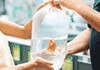
When you purchase your fish they should be placed in strong bags which will have either rounded corners, or will be 'double-bagged' so that corners are folded up - this is to prevent fish getting stuck during transport. Bags should be filled with roughly a quarter water and three quarters air, since fish will run out of oxygen before water! Bags should then be placed inside either a dark bag or most commonly a brown paper bag, this is to block out excess light and visible movement so that the fish remain calm whilst they are transported. If you have a long distance to cover before the fish reach their destination then it is wise to advise your retailer who may take extra measures when packing your fish such as providing a polystyrene box to minimise heat loss or gain. Once you are ready to place your fish in their new environment there are a number of steps that should be taken to avoid stress to the fish:
1) Turn off the lights in the aquarium; bright light may disturb the new fish.
2) Float the bags containing the new fish in the aquarium. If they have travelled for more than 20 minutes then open the bags to allow air in. The sides of the bags can be rolled down to create a 'floating rim', keeping the bag upright.
3) After about 15-20 minutes the temperature of the water in the bag should have equalised to that of the aquarium water. The fish can now be gently released from the bag by slowly tipping into the aquarium.
4) Leave the aquarium lights off for another few hours or for the rest of the day, in most cases the new fish will not need to be fed and may be unwilling to feed but it may be wise to feed the existing fish to divert their attentions away from the new fish.
Although some fish prefer brackish, hard, or soft water, a retailer may keep these fish in significantly different conditions. Reasons for this vary but in most cases it is to provide local fish keepers with fish that are used to the local water conditions. This is not a reflection on the retailer's ability to provide correct water conditions, as many fish will live quite happily in water conditions outside of those found in their natural environment. If however, you are keeping a soft water aquarium in a hard water area, you may find that your retailer keeps some soft water fish, such as many tetras, in the local hard water. If the difference in hardness or pH is quite significant (around 10dGH or a pH difference of +/-1), then you may need to set up an acclimatisation aquarium. The new fish can be placed in the acclimatisation aquarium with water conditions similar to your retailers and then those conditions can be slowly changed over a few weeks to match those of your aquarium.
Brackish fish may need to be acclimatised over a longer period and regular additions of aquarium water to the bag will help to minimise differences in salinity. If the salinity of your brackish aquarium is significantly different to the water from which the fish were taken then you may have to set up an acclimation tank in which the salinity can be raised (or lowered) over a period of days or even weeks. Many brackish fish are kept by retailers in freshwater, or very low salinity water, to cater for the widest possible audience. Further research on the fish species in question will help you to acclimate them correctly - some brackish fish experience sudden fluctuations in salinity during short periods in their natural (wild) habitat and may be acclimatised quickly whilst others are used to more stable conditions and will need to be acclimated slowly.

If you are acclimatising freshwater fish the only parameter that can be equalised in a short period of time is temperature, which is best done by floating the fish for 15-20 minutes. Fish may take days or even weeks to fully adjust to changes in pH, hardness and water pollutants, so mixing will not help, and may even further stress the fish during their temperature acclimation. Mixing is only required when there are differences in salinity, such as with brackish or marine fish.
Maintenance such as water changes, gravel cleans, and filter cleans, are essential parts of good aquarium care, but they are also disruptive to the aquarium environment. New fish need time to settle with as little disruption as possible so it is best to introduce new fish a few days after maintenance and a week before any further maintenance.


Like what you read? Support this site by buying a product from our partner. Check out these fish tanks and products today
Hello do you have a question about tropical fish care? Do feel free to ask our experts.We have 1000's of posts about the very topics you're interested in covering all aspects of tropical fish; their habitats, best ways to keep them thriving, where to buy, from whom and more!
Helping Fishkeepers With Their Fishkeeping Needs Since 2006